Flash USDT Creation and Usage on ChainIDE Platform
Flash USDT refers to a novel method of creating and interacting with USDT-like tokens leveraging ChainIDE and MetaMask within the Ethereum ecosystem. This approach focuses on using smart contracts coded in Solidity, deployed on Ethereum, and tested in a controlled development environment to simulate USDT token behavior.
Understanding Flash USDT and Its Concept
Flash USDT is essentially a custom ERC20 token that mimics USDT attributes but is created through a newly discovered workflow on ChainIDE, a web-based blockchain IDE. This method allows developers and users to create and test tokens without relying on official USDT contracts, primarily for educational and development purposes. The process involves deploying a smart contract that follows the ERC20 standard, enabling token transfer, balance tracking, and wallet integration.
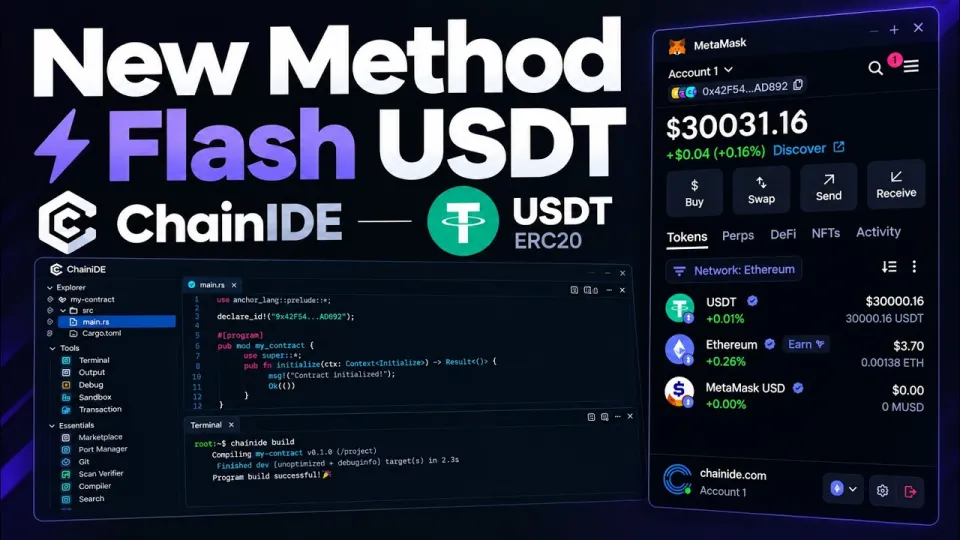
ChainIDE Setup and Smart Contract Development
ChainIDE (https://chainide.com/) offers a comprehensive platform for writing, compiling, and deploying smart contracts on Ethereum-compatible test networks. To create Flash USDT, users start by setting up a new Solidity project within ChainIDE, importing or writing the ERC20 token contract code designed for Flash USDT. The environment supports contract compilation, debugging, and interaction, making it suitable for both beginners and experienced developers.
Integrating MetaMask and Interacting with Flash USDT
MetaMask acts as the user wallet interface connecting to Ethereum networks. After deploying the Flash USDT smart contract via ChainIDE, users link their MetaMask wallet to the Ethereum test network where the contract resides. This enables sending and receiving Flash USDT tokens, approving transactions, and checking token balances directly within the wallet interface. Proper connection and network selection in MetaMask are critical to ensure secure and successful interactions.
ERC20 Token Structure and Contract Workflow
The Flash USDT smart contract follows the ERC20 token standard, which includes key functions such as `totalSupply()`, `balanceOf()`, `transfer()`, `approve()`, and `transferFrom()`. The contract maintains internal ledgers of token balances and allowances to facilitate transfers and delegated spending. The workflow from ChainIDE involves writing the contract code, compiling it, deploying to a testnet, and then verifying the contract's source code for transparency and security.
Testing, Verification, and Common Mistakes
Before interacting with any Flash USDT contract, rigorous testing on test networks is recommended. This involves sending test tokens between accounts, verifying transaction success, and checking contract logs. Common mistakes include incorrect network selection in MetaMask, deploying incomplete contracts, or interacting with unverified or malicious contracts. Users must always confirm contract addresses and source code authenticity to avoid scams or fund loss.
Security Considerations and Best Practices
Flash USDT, being a test or custom token, should never be used with real funds unless thoroughly audited. The method demonstrated relies on educational use and development testing. Always confirm the legitimacy of any smart contract, use MetaMask's transaction review features carefully, and never share private keys. Understanding the underlying Solidity code and Ethereum network interactions is essential for safe usage.
Useful Links
- ChainIDE official site for smart contract development: https://chainide.com/
- Flash USDT creation script and guide: https://sites.google.com/view/defiflashusdt
Итог
The Flash USDT method presented by the Rca FastPrint channel showcases an innovative way to create and interact with ERC20 tokens using ChainIDE and MetaMask. This workflow is valuable for developers and enthusiasts aiming to understand token creation and smart contract deployment on Ethereum. Always prioritize security by verifying contract code and testing thoroughly before any real asset involvement. For more insights and detailed tutorials, visit ChainIDE and follow Rca FastPrint’s educational content.
Key takeaways
- Flash USDT is an ERC20 token method developed using ChainIDE and MetaMask.
- ChainIDE provides an integrated development environment for smart contract coding and testing.
- The method involves creating and interacting with smart contracts on the Ethereum network.
- Flash USDT creation requires careful verification of contract code to avoid scams.
- The process includes wallet integration, contract deployment, and testing steps.
Source: Flash USDT | Found a NEW Method on ChainIDE · Markdown version
Questions & answers
What is Flash USDT and how does it differ from official USDT?
Flash USDT is a custom ERC20 token created using a new method on ChainIDE for educational and testing purposes. Unlike official USDT, it is not backed by Tether and should not be used for real transactions without verification.
How does ChainIDE facilitate the creation of Flash USDT?
ChainIDE is a web-based integrated development environment that allows users to write, compile, deploy, and test smart contracts like Flash USDT on Ethereum test networks. It simplifies the development workflow for token creation.
What role does MetaMask play in interacting with Flash USDT tokens?
MetaMask serves as a wallet interface connecting to the Ethereum network. It allows users to manage Flash USDT tokens by approving transactions, sending tokens, and viewing balances after the token contract is deployed.
Is it safe to use Flash USDT tokens with real funds?
No, Flash USDT tokens are intended for educational and testing purposes only. Users should never send real funds to unverified or unknown contracts and must always verify contract authenticity and code before any real asset interaction.